
Sanitary Temperature Instruments: A Guide to Temperature Measurement in Hygienic Applications
In food and beverage, pharmaceutical, biotechnology, and other hygienic processing industries, accurate temperature measurement is essential. However, choosing a temperature instrument for a sanitary application involves more than simply selecting a thermometer with the right temperature range.
The instrument must also be compatible with the process, easy to clean, resistant to contamination, and designed for hygienic installation.
This guide explains the most common types of sanitary temperature instruments, how they are installed, and what to consider when selecting one for your application.
What Is a Sanitary Temperature Instrument?
A sanitary temperature instrument is designed for applications where hygiene, cleanability, and contamination control are important.
Unlike conventional industrial temperature instruments, sanitary instruments are typically designed with smooth, cleanable surfaces and process connections that minimize areas where product, bacteria, or contaminants can accumulate.
Common applications include:
Food and beverage processing
Dairy processing
Pharmaceutical manufacturing
Biotechnology
Cosmetics manufacturing
Breweries and beverage production
Clean-in-place (CIP) systems
Process vessels and sanitary piping
Depending on the application, temperature can be measured using a bimetal thermometer, RTD, thermocouple, or electronic temperature transmitter.
Common Types of Sanitary Temperature Instruments
1. Sanitary Bimetal Thermometers
Sanitary bimetal thermometers provide a simple and reliable way to obtain a local temperature reading.
They typically consist of a mechanical temperature-sensing element connected directly to a dial. Many models are available with Tri-Clamp process connections, making them suitable for hygienic piping and vessels.
Advantages include:
No external power required
Simple operation
Easy-to-read local indication
Relatively low cost
Suitable for many food and beverage applications
For applications where operators simply need to see the process temperature locally, a sanitary bimetal thermometer can be a practical solution.
2. Sanitary RTD Temperature Sensors
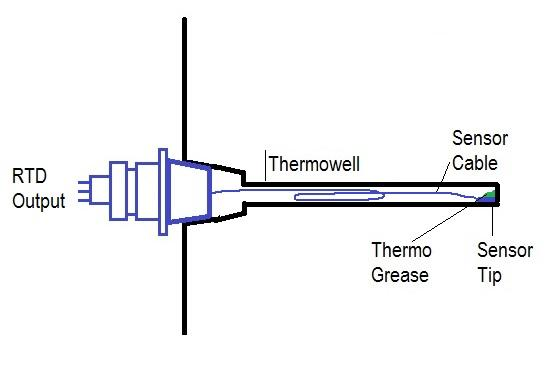
RTDs (Resistance Temperature Detectors) are widely used when higher measurement accuracy and the ability to integrate with a control or monitoring system are required.
A common configuration is a Pt100 or Pt1000 RTD installed through a sanitary process connection.
The RTD changes electrical resistance as temperature changes. The connected transmitter, PLC, data acquisition system, or monitoring device can then convert that resistance into a temperature reading.
Sanitary RTDs are commonly used in:
Pharmaceutical processes
Bioreactors
Process vessels
Food processing equipment
CIP systems
Temperature monitoring systems
3. Sanitary Thermocouples
Thermocouples generate a small electrical voltage that varies with temperature. They are useful for applications requiring a relatively wide temperature range and fast response.
Although RTDs are often preferred when accuracy and stability are important, thermocouples can be appropriate for certain process applications.
Common thermocouple types include Type J and Type K, although the appropriate sensor depends on the temperature range and process requirements.
What Is a Tri-Clamp Temperature Connection?
One of the most common process connections used with sanitary temperature instruments is the Tri-Clamp connection.
A Tri-Clamp connection uses two ferrules, a gasket, and a clamp to create the process connection
Compared with threaded industrial connections, Tri-Clamp connections can be easier to disassemble and clean. This makes them particularly useful in hygienic process environments.
Common sanitary connection sizes include 1.5-inch and 2-inch Tri-Clamp connections, although other sizes and configurations are available.
Sanitary Thermometer vs. RTD: Which Should You Choose?
The right instrument depends largely on how the temperature measurement will be used.
Requirement | Sanitary Bimetal Thermometer | Sanitary RTD |
Local temperature display | Excellent | Requires indicator/transmitter |
Electrical signal | No | Yes |
Process monitoring system | Limited | Excellent |
Simple installation | Excellent | Good |
Continuous data logging | No | Yes |
Low-cost local indication | Excellent | Depends on configuration |
Automated control | No | Yes |
If an operator simply needs to read the temperature at the process, a sanitary dial thermometer may be sufficient.
If the temperature needs to be recorded, transmitted, monitored, or integrated into a control system, an RTD is generally the better choice.
Important Factors When Selecting a Sanitary Temperature Instrument
Temperature Range
Select an instrument with a temperature range appropriate for the actual process.
Consider both normal operating temperatures and any cleaning or sterilization temperatures the instrument may experience.
Process Connection
The process connection must match the equipment and piping.
For hygienic applications, Tri-Clamp connections are common, but the required size and configuration should be confirmed before ordering.
Wetted Material
The portion of the instrument exposed to the process should be compatible with the application.
316 stainless steel is commonly used for sanitary temperature instruments because of its corrosion resistance and suitability for many hygienic applications.
Accuracy
Accuracy requirements depend on the process.
For simple monitoring, a mechanical thermometer may provide sufficient accuracy. More demanding pharmaceutical, biotechnology, or process-control applications may require an RTD with a calibrated measurement system.
Sensor Type
Common options include:
Pt100 RTD
Pt1000 RTD
Type J thermocouple
Type K thermocouple
Bimetal sensing element
The appropriate sensor depends on the required accuracy, temperature range, response time, and control system.
Calibration
For applications where temperature measurement is part of a regulated or quality-controlled process, calibration can be an important consideration.
A calibrated instrument can provide documented evidence that the measurement is performing within the required accuracy.
For critical applications, customers may specify calibration against traceable standards and require calibration documentation with the instrument.
Sanitary Temperature Measurement in Pharmaceutical and Biotech Applications
Temperature measurement can be particularly important in pharmaceutical and biotechnology manufacturing.
Processes may involve controlled temperatures during manufacturing, storage, cleaning, and other operations. Temperature instruments may therefore need to be selected based on not only measurement performance but also the requirements of the overall quality system.
In these applications, factors such as:
Accuracy
Repeatability
Calibration
Material compatibility
Cleanability
Documentation
Process connection
can all influence instrument selection.
Why Proper Installation Matters
Even a high-quality temperature instrument can produce poor results if it is installed incorrectly.
The sensing element should be positioned where it can accurately represent the process temperature.
Important considerations include:
Sensor insertion depth
Location within the piping or vessel
Process flow
Heat transfer
Connection orientation
Dead legs and hygienic design
Accessibility for inspection and calibration
For RTDs, the sensor should also be properly connected to the measurement system and configured for the correct sensor type and wiring arrangement.
Conclusion
Selecting a sanitary temperature instrument requires consideration of more than temperature range alone. The process connection, materials, sensor technology, accuracy, installation, and calibration requirements should all be evaluated.
For simple local indication, a sanitary bimetal thermometer can provide a straightforward solution. For applications requiring electronic monitoring, data acquisition, or process control, a sanitary RTD or thermocouple may be more appropriate.
By matching the temperature instrument to the application, manufacturers can improve measurement reliability while maintaining the hygienic requirements of their process.
Looking for a sanitary temperature instrument for your application? Zedqo can help you identify the appropriate temperature measurement solution based on your process, connection size, temperature range, and accuracy requirements.
Comments